The history keeps returning.
What remains unresolved finds its way into the present.
CounterStories Consulting
CounterStories helps institutions, communities, and leaders confront inherited harm, transform entrenched conflict, and create a shared path forward.
Meet DavidWhen the usual approaches aren’t enough
Sometimes the conflict in front of you did not begin with the people now being asked to solve it.
Institutions inherit histories, loyalties, structures, wounds, language, and ways of working.
Over time, those histories can surface as leadership tension, recurring conflict, stalled initiatives, fractured trust, mission fatigue, or an inability to agree on what should come next.
And sometimes the invitation is not a problem at all. It is a sense that something more is possible, but the language, relationships, or conditions needed to reach it have not yet taken form.
That is often where David’s work begins.
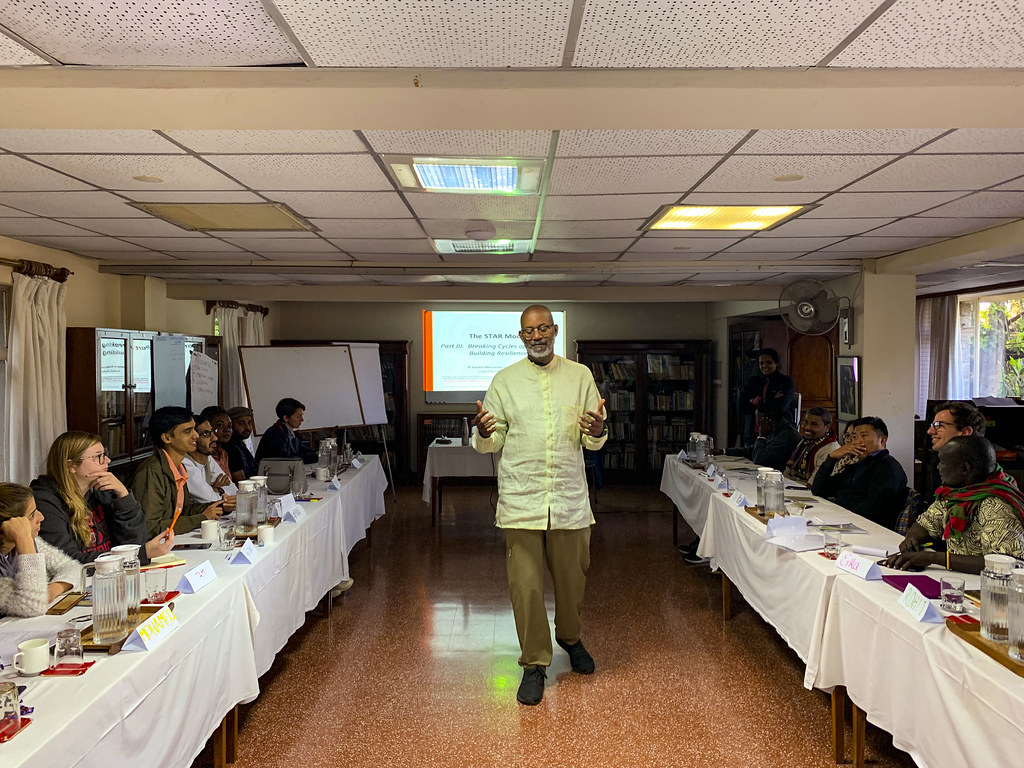
What remains unresolved finds its way into the present.
People share a mission but struggle to see a path they can take together.
The conversation changes; the underlying tension remains.
More than conflict management
Many valuable approaches begin with the visible issue.
Mediation may help resolve a dispute.
Strategy may clarify direction.
Coaching may strengthen leadership.
Facilitation may create a more civil conversation.
These approaches can be valuable.
But when the underlying narratives remain unchanged, even good work can remain bounded by the same horizon of possibility.
A strategy can reproduce assumptions inherited from the past.
A leader can become more effective while still operating inside a narrative no one has learned to question.
A conversation can become more productive without changing what people believe is actually possible.
CounterStories asks a different question:
The work helps surface and reshape those deeper narratives so mediation, strategy, leadership, dialogue, and action can operate from a wider field of possibility.
“You tried resolution. I offer transformation.”
The CounterStories approach
Every engagement is shaped around the context in front of us, but the work often moves through three interconnected movements.
RECKON
OPEN
IMAGINE
Not a future without struggle — a future people can find reason to struggle toward together.
The work creates language for belonging, shared meaning, trustworthy partnership, and a future people can recognize themselves within and participate in shaping.
Work with David
Some institutions need one consequential conversation. Others need sustained accompaniment through a deeper transformation.
When the moment needs a different kind of conversation.
When the work needs time to become something people can actually live.
When carrying the moment requires somewhere to think honestly.
When the moment suggests the work needs to continue after David leaves the room.
When an idea needs to enter a larger room.
Selected experience

Stories from the work
Community Power & Trust in Atlanta
Annie E. Casey Foundation
Let’s begin
You do not need a perfectly defined problem or a finished brief.
In fact, it may be useful not to arrive with the challenge already fixed in place.
Maybe something needs attention.
Maybe something keeps returning.
Maybe a transition is opening new questions.
Or maybe you can sense a possibility that has not yet found enough language or form.
Tell David what you are noticing.
